



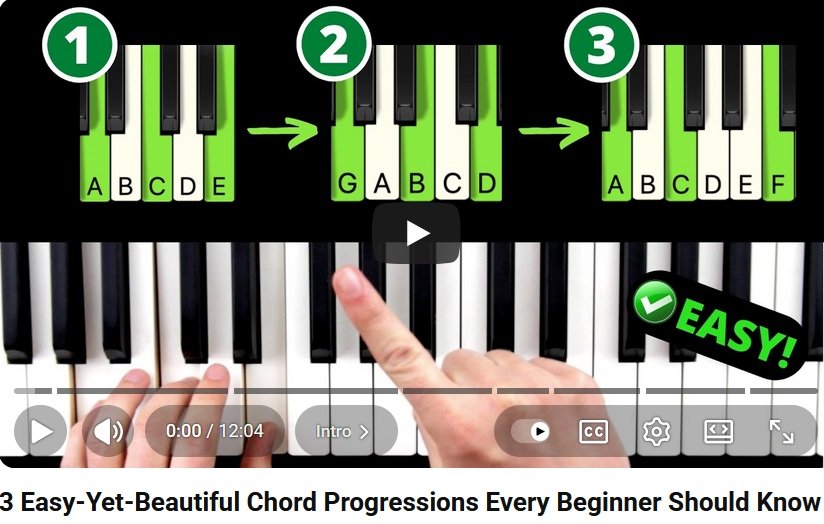
 Discover three beautiful and easy chord progressions—the pop, emotional, and catchy progressions—that every beginner pianist can learn. This guide covers chord shapes, left-hand root notes, popular songs using these progressions, and rhythmic 'money patterns' to bring your playing to life. Plus, access cheat sheets and bonus videos to master smooth transitions and unlock hundreds of songs. Learning piano can be both exciting and overwhelming, especially when starting out. Fortunately, mastering just a few chord progressions can open the door to playing hundreds of your favorite songs. In this guide, we'll explore three gorgeous chord progressions that are perfect for beginners: the Pop Progression, the Emotional Progression, and the Catchy Progression. Along the way, you'll also learn some music theory basics, finger strength exercises, and rhythmic patterns to make your playing more dynamic. The Pop Progression What It Sounds Like The Pop Progression has a bright, catchy sound commonly heard in many radio hits. Here's the chord sequence: - C Major (notes: G, C, E) Playing the Left Hand Your left hand will play the root note of each chord: - C for C Major Putting It Together When combined, the progression sounds like this: `C - G - Am - F` Popular Songs Using This Progression This progression is incredibly versatile and appears in many popular songs, such as: - "Forever Young" by Alphaville Learning this progression allows you to play hundreds of songs with just these four chords. The Emotional Progression Overview Known for its heartfelt and poignant sound, the Emotional Progression is perfect for ballads and sad pop songs. Interestingly, it uses the same chords as the Pop Progression but in a different order: - A Minor Left Hand Root Notes Play the root notes in this order: `A - F - C - G` Sound Sample This progression creates a deep emotional resonance, often heard in songs like: - "All of Me" by John Legend Adding Rhythmic Patterns Using rhythmic variations, or "money patterns," can bring this progression to life. For example, playing the chords with different rhythms adds texture and emotion. The Catchy Progression Description Sometimes called the "Car Ride Progression," this sequence is perfect for upbeat, catchy tunes that sound great while cruising: - F Major Left Hand Notes Play the root notes: `F - C - G - A` Popular Songs This progression is featured in songs like: - "If I Die Young" by The Band Perry Mastering Smooth Transitions with the Added Chord Method If you find it challenging to coordinate your hands or switch chords smoothly, the Added Chord Method can help. This technique breaks down chords into smaller parts to build finger confidence and muscle memory. Detailed instructions and a step-by-step video are available on the bonus resources page. Bringing Progressions to Life with Money Patterns Money patterns are rhythmic variations of the chords you’ve learned. By changing the rhythm while playing the same notes, you can add interest and groove to your playing. Examples For the Pop Progression (C, G, Am, F), you might try: - Playing chords in a steady rhythm There are six money patterns categorized as beginner, intermediate, and advanced. Video tutorials for each are available on the bonus page. Unlocking Hundreds of Songs A comprehensive list of songs that use these chord progressions is available online. Songs are categorized by their chord progression using Roman numeral notation: - Pop Progression: I–V–vi–IV By learning these three progressions, you can play hundreds of songs across various genres. Playing Progressions Anywhere on the Keyboard You’re not limited to playing these chords in one position. As long as the notes align, you can play the same progression higher or lower on the keyboard to create different moods and textures. Getting Your Cheat Sheet and Bonus Videos To make learning easier, a cheat sheet with chord diagrams, song lists, and money patterns is available. Bonus videos include: - The Added Chord Method for smooth transitions These resources are designed to simplify your piano journey and help you progress quickly. Final Thoughts Mastering these three chord progressions will give you a solid foundation to play a wide variety of songs and develop your piano skills. Remember to practice regularly, use the cheat sheets and videos, and most importantly, enjoy the process of making music. Happy practicing! Piano Chords Related Articles
|