Understanding Slash Chords: A Guide to Enhancing Your Music
Slash chords can seem confusing at first, but they are simply chords played with a different bass note. This article explains what slash chords are, how to interpret them, and how they add beauty and complexity to music. It covers chord inversions, examples of slash chords in songs, and tips for experimenting with them creatively.
Slash chords can often be a source of confusion for many musicians, especially when first encountered on a chord chart. However, they don't have to be intimidating. In fact, slash chords can add a lot of beauty and depth to your playing. This article will explain what slash chords are, how to interpret them, and how you can use them to enrich your music.
What is a Slash Chord?
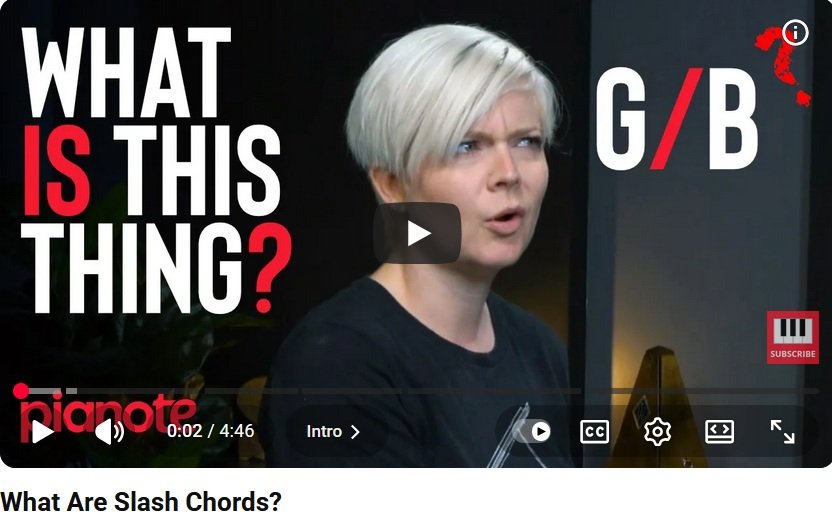
A slash chord is written with two parts separated by a slash, for example, G/B. The chord before the slash is the main chord you are playing, and the note after the slash is the bass note you play underneath it.
For instance, if you see G/B, you are playing a G major chord, but instead of playing the root note G in the bass, you play the note B in the bass. This is often called "G over B".
Think of the slash as meaning "over top of". So G/B means "G chord over B bass note".
How Slash Chords Work
Let's take the G major chord as an example. The notes in a G major chord are G, B, and D. When you play a G chord in root position, the bass note is G. However, if you play G/B, you are playing the same G major chord but with B as the bass note.
This creates a different sound and feeling. The bass note B is the third of the G chord, and it gives a sense of lift and movement. It can make the music feel like it is going on a wonderful adventure.
Chord Inversions
Slash chords often indicate chord inversions. A chord inversion is when you change the order of the notes so that a note other than the root is in the bass.
For example, the G major chord in root position is G-B-D. The first inversion is B-D-G, where B is the bass note. This is exactly what G/B represents.
Playing chords in different inversions can add variety and smooth transitions between chords.
Slash Chords with Non-Chord Tones
Sometimes, slash chords include bass notes that are not part of the main chord. These can create tension or a "crunchy" sound, which can be used effectively in music.
For example, in the song "A Whiter Shade of Pale," you might see chords like C, then C/B, then A minor, then A minor/G. The C/B chord has a B in the bass, which is not a chord tone of C major, creating a descending bass line that leads the ear smoothly to the next chord.
While these slash chords can sound unusual or tense on their own, they serve a musical purpose by connecting chords and adding emotional depth.
How to Use Slash Chords in Your Playing
When you see a slash chord:
1. Identify the main chord (the part before the slash).
2. Identify the bass note (the part after the slash).
3. Play the main chord with your right hand.
4. Play the bass note with your left hand.
You can experiment with different bass notes under the same chord to discover new sounds. For example, try playing a D major chord with the third (F#) or the fifth (A) in the bass and listen to how the sound changes.
You can also try bass notes that are not in the chord or scale to create unique effects, but be mindful of how they fit within the music.
Experiment and Have Fun
Slash chords open up many creative possibilities. Don't be afraid to try different combinations and see what sounds good to you. Sometimes, what seems like a mistake can lead to a beautiful discovery.
Feel free to share your favorite slash chords and how you use them in your music.
Conclusion
Slash chords are a powerful tool for musicians to add color, movement, and emotion to their playing. By understanding that the chord before the slash is the main chord and the note after the slash is the bass note, you can easily interpret and use slash chords.
Whether used as chord inversions or as creative bass note choices, slash chords can enhance your music and inspire new ideas. So next time you see a slash chord, embrace it as an opportunity to explore and enrich your sound.
Piano Chords Related Articles
- How to Master Your Chords On Piano in One Hour
- The Most Effective Practice For Learning Piano Chords
- 3 Easy Yet Beautiful Chord Progressions Every Beginner Should Know
- How To Play C Major Scale & Chords - SIMPLE Piano Theory
- How to play CLOSER - Chainsmokers ft. Halsey Piano Chords Accompaniment Tutorial
- How to play HERE'S YOUR PERFECT - Jamie Miller Piano Tutorial | Chords Accompaniment
- How to Quickly Play Piano by Ear - Nigerian Worship Chords
- What Are Slash Chords?