



How To Play C Major Scale & Chords - SIMPLE Piano Theory
Mastering the C Major Scale and Chords on Piano
Learn how to play the C major scale and its associated chords on the piano with step-by-step finger positioning and exercises. This guide covers both hands playing together, finger techniques, and the seven chords within the C major key, providing a solid foundation for beginners and practical knowledge for playing songs in C major.
Playing the C major scale and understanding its chords is fundamental for any piano player, especially beginners. This guide will walk you through the notes of the C major scale, finger positioning for both hands, exercises to coordinate your hands, and the chords that naturally occur within the C major key. By mastering these, you will be able to recognize and play songs written in the key of C with confidence.
The C Major Scale Notes
The C major scale consists of the following notes:
C - D - E - F - G - A - B - C
These notes form the foundation of the scale and are played in sequence ascending and descending.
Finger Positioning for the Right Hand
To play the C major scale smoothly with your right hand, follow these finger suggestions:
1. Place your thumb (finger 1) on C.
2. Play D with finger 2.
3. Play E with finger 3.
4. Tuck your thumb under to play F (finger 1).
5. Continue with fingers 2, 3, 4, and 5 for G, A, B, and the higher C respectively.
When descending, start with finger 5 on the high C and play down to finger 1 on F, then cross your third finger over to play E, followed by fingers 2 and 1 on D and C.
Summary of Right Hand Fingering
- Ascending: 1 (C), 2 (D), 3 (E), tuck thumb under to 1 (F), 2 (G), 3 (A), 4 (B), 5 (C)
- Descending: 5 (C), 4 (B), 3 (A), 2 (G), 1 (F), cross over with 3 (E), 2 (D), 1 (C)
Finger Positioning for the Left Hand
For the left hand, the fingering is slightly different:
1. Place your pinky (finger 5) on C.
2. Play D with finger 4.
3. Play E with finger 3.
4. Cross your third finger over to play F (finger 2).
5. Continue with fingers 1, 2, 3, and 4 for G, A, B, and the higher C respectively.
When descending, start with finger 1 on the high C and play down to finger 5 on the low C, tucking your thumb under as needed.
Summary of Left Hand Fingering
- Ascending: 5 (C), 4 (D), 3 (E), cross over with 2 (F), 1 (G), 2 (A), 3 (B), 4 (C)
- Descending: 4 (C), 3 (B), 2 (A), 1 (G), tuck thumb under to 3 (F), 2 (E), 1 (D), 5 (C)
Coordinating Both Hands
Once comfortable with each hand separately, try playing the scale with both hands together. Start by placing your right hand thumb and left hand pinky on middle C. Play each note of the scale simultaneously with both hands, ascending and descending.
This exercise helps develop finger strength and coordination. It may be tricky at first, especially when changing finger positions, but with practice, you can increase speed and fluidity.
The Chords in the Key of C Major
Understanding the chords built from the C major scale notes is essential for playing and composing music. Each note of the scale serves as the root of a chord formed by stacking thirds.
Here are the seven chords in the key of C major:
1. **C Major (C - E - G)**
2. **D Minor (D - F - A)**
3. **E Minor (E - G - B)**
4. **F Major (F - A - C)**
5. **G Major (G - B - D)**
6. **A Minor (A - C - E)**
7. **B Diminished (B - D - F)**
The eighth chord is the octave of the root, C major, completing the scale.
Practical Application
Knowing these chords and the scale allows you to quickly identify and play songs in the key of C. When you see a chord progression or a melody, you can understand which notes and chords fit naturally.
Additional Resources
For further practice, printable PDFs and additional lessons are available at simplifiedpiano.com, which provide structured exercises and theory explanations.
Conclusion
Mastering the C major scale and its chords is a vital step in your piano journey. With consistent practice of finger positioning, hand coordination, and chord recognition, you will build a strong foundation for playing a wide variety of music.
Keep practicing, and enjoy the process of making music!
Piano Chords Related Articles
- How to Master Your Chords On Piano in One Hour
- The Most Effective Practice For Learning Piano Chords
- 3 Easy Yet Beautiful Chord Progressions Every Beginner Should Know
- How To Play C Major Scale & Chords - SIMPLE Piano Theory
- How to play CLOSER - Chainsmokers ft. Halsey Piano Chords Accompaniment Tutorial
- How to play HERE'S YOUR PERFECT - Jamie Miller Piano Tutorial | Chords Accompaniment
- How to Quickly Play Piano by Ear - Nigerian Worship Chords
- What Are Slash Chords?
The Most Effective Practice For Learning Piano Chords

Master Piano Chords Quickly with the Function Method
Learn an effective three-step approach to mastering major and minor piano chords quickly using the function method. This method focuses on understanding chords by their function within a major scale, enabling you to play chords on the fly. Follow a structured 3-month practice routine to master all essential chords and improve your piano skills efficiently.
Do you struggle to figure out your piano chords quickly and easily? If yes, the problem might be that you learned your piano chords by measuring the distance between notes. While this approach is not bad for beginners, it is ultimately slow and impractical for playing chords on the fly.
In this article, we will explore the ultimate approach to practicing piano chords using a simple three-step method called the function method. By following this approach, you will be able to figure out any major or minor chord quickly and easily. Additionally, we will share a practice routine designed to help you master your most important piano chords in just three months.
Common Approach to Learning Piano Chords
Most students learn piano chords by counting half steps between notes. For example, to play a C major chord, you start on C, go up four half steps to E, then up three half steps to G. Similarly, for an E major chord, you start on E, go up four half steps, then three half steps.
For minor chords, such as F minor, the process is similar but with a different pattern: start on F, go up three half steps, then four half steps.
While this method helps beginners understand chord construction, it requires constant measuring and is not practical for quick chord recognition or improvisation.
The Function Method: A Better Way to Learn Chords
The function method is a simple and effective way to learn all your major and minor chords by understanding their function within a major scale. This method involves three steps:
Step 1: Start with a Major Scale
Begin with a major scale, such as the C major scale, which consists of all white notes starting on C. Assign numbers to each note of the scale:
- C = 1
- D = 2
- E = 3
- F = 4
- G = 5
- A = 6
- B = 7
Step 2: Stack Third Intervals on Each Scale Note
For each note in the scale, build a chord by stacking two third intervals. This means skipping one note in the scale each time you add a note to the chord.
- Starting on C (1), skip D and play E, then skip F and play G. This forms a C major chord.
- Starting on D (2), skip E and play F, then skip G and play A. This forms a D minor chord.
Applying this to all scale degrees results in the following chords:
- 1 (C): Major
- 2 (D): Minor
- 3 (E): Minor
- 4 (F): Major
- 5 (G): Major
- 6 (A): Minor
- 7 (B): Diminished
Step 3: Memorize the Diatonic Chord Formula
The formula for chords built on each scale degree in a major key is:
Major - Minor - Minor - Major - Major - Minor - Diminished
Memorizing this formula helps you quickly identify the quality of chords based on their scale degree without counting half steps.
Why This Method Works
Most popular music uses chords derived from the major scale, known as diatonic chords. By practicing these chords in various keys, you can quickly and easily play many common chord progressions.
For example, common pop progressions use chords like 1, 4, 5, and 6, all of which fit into the diatonic chord framework.
Practice Routine to Master Chords in 3 Months
To effectively learn and master your major and minor chords, follow this weekly practice routine:
Week 1: Key of C Major
- Practice playing the C major scale.
- Play each diatonic chord in the key of C (C major, D minor, E minor, F major, G major, A minor, B diminished).
- Practice hands separately and together.
- Experiment with different chord patterns and inversions.
Week 2: Key of D♭ Major
- Practice the D♭ major scale.
- Build and play all diatonic chords in D♭ major.
Subsequent Weeks
- Continue moving up by half steps each week, practicing the major scale and diatonic chords in each key.
- Follow the full 3-month lesson plan to cover all 12 keys.
This structured approach ensures you develop familiarity and dexterity with chords in every key.
Additional Resources
For those interested in a deeper dive, consider exploring courses that cover:
- All diatonic chords in every key
- Common chord progressions
- Best fingerings
- Techniques to improve speed and dexterity
These resources often include downloadable and printable sheet music, as well as smart sheet music that allows you to change keys with a click.
Conclusion
Learning piano chords by function within a major scale is a powerful and efficient method. It eliminates the need to count half steps constantly and helps you understand the relationship between chords and scales.
By following the three-step function method and committing to a consistent practice routine, you can master your major and minor chords in just three months. This foundation will enable you to play a wide variety of music confidently and with ease.
Happy practicing!
Piano Chords Related Articles
- How to Master Your Chords On Piano in One Hour
- The Most Effective Practice For Learning Piano Chords
- 3 Easy Yet Beautiful Chord Progressions Every Beginner Should Know
- How To Play C Major Scale & Chords - SIMPLE Piano Theory
- How to play CLOSER - Chainsmokers ft. Halsey Piano Chords Accompaniment Tutorial
- How to play HERE'S YOUR PERFECT - Jamie Miller Piano Tutorial | Chords Accompaniment
- How to Quickly Play Piano by Ear - Nigerian Worship Chords
- What Are Slash Chords?
3 Easy Yet Beautiful Chord Progressions Every Beginner Should Know
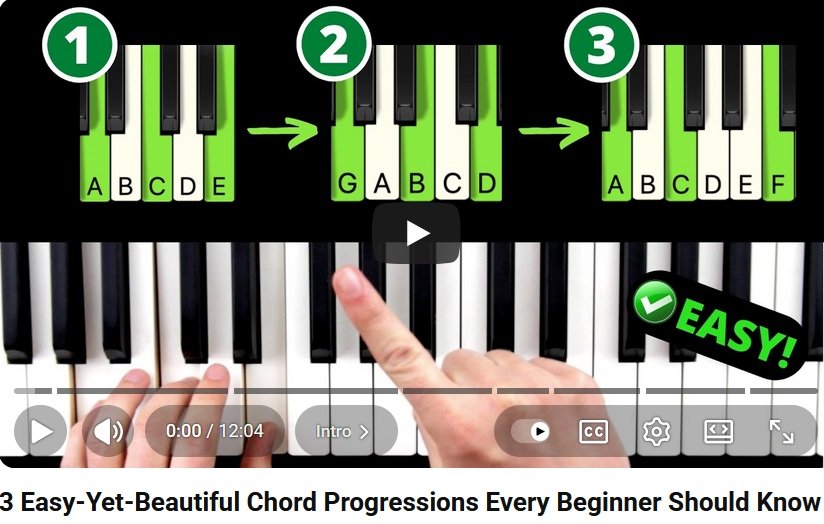 Discover three beautiful and easy chord progressions—the pop, emotional, and catchy progressions—that every beginner pianist can learn. This guide covers chord shapes, left-hand root notes, popular songs using these progressions, and rhythmic 'money patterns' to bring your playing to life. Plus, access cheat sheets and bonus videos to master smooth transitions and unlock hundreds of songs. Learning piano can be both exciting and overwhelming, especially when starting out. Fortunately, mastering just a few chord progressions can open the door to playing hundreds of your favorite songs. In this guide, we'll explore three gorgeous chord progressions that are perfect for beginners: the Pop Progression, the Emotional Progression, and the Catchy Progression. Along the way, you'll also learn some music theory basics, finger strength exercises, and rhythmic patterns to make your playing more dynamic. The Pop Progression What It Sounds Like The Pop Progression has a bright, catchy sound commonly heard in many radio hits. Here's the chord sequence: - C Major (notes: G, C, E) Playing the Left Hand Your left hand will play the root note of each chord: - C for C Major Putting It Together When combined, the progression sounds like this: `C - G - Am - F` Popular Songs Using This Progression This progression is incredibly versatile and appears in many popular songs, such as: - "Forever Young" by Alphaville Learning this progression allows you to play hundreds of songs with just these four chords. The Emotional Progression Overview Known for its heartfelt and poignant sound, the Emotional Progression is perfect for ballads and sad pop songs. Interestingly, it uses the same chords as the Pop Progression but in a different order: - A Minor Left Hand Root Notes Play the root notes in this order: `A - F - C - G` Sound Sample This progression creates a deep emotional resonance, often heard in songs like: - "All of Me" by John Legend Adding Rhythmic Patterns Using rhythmic variations, or "money patterns," can bring this progression to life. For example, playing the chords with different rhythms adds texture and emotion. The Catchy Progression Description Sometimes called the "Car Ride Progression," this sequence is perfect for upbeat, catchy tunes that sound great while cruising: - F Major Left Hand Notes Play the root notes: `F - C - G - A` Popular Songs This progression is featured in songs like: - "If I Die Young" by The Band Perry Mastering Smooth Transitions with the Added Chord Method If you find it challenging to coordinate your hands or switch chords smoothly, the Added Chord Method can help. This technique breaks down chords into smaller parts to build finger confidence and muscle memory. Detailed instructions and a step-by-step video are available on the bonus resources page. Bringing Progressions to Life with Money Patterns Money patterns are rhythmic variations of the chords you’ve learned. By changing the rhythm while playing the same notes, you can add interest and groove to your playing. Examples For the Pop Progression (C, G, Am, F), you might try: - Playing chords in a steady rhythm There are six money patterns categorized as beginner, intermediate, and advanced. Video tutorials for each are available on the bonus page. Unlocking Hundreds of Songs A comprehensive list of songs that use these chord progressions is available online. Songs are categorized by their chord progression using Roman numeral notation: - Pop Progression: I–V–vi–IV By learning these three progressions, you can play hundreds of songs across various genres. Playing Progressions Anywhere on the Keyboard You’re not limited to playing these chords in one position. As long as the notes align, you can play the same progression higher or lower on the keyboard to create different moods and textures. Getting Your Cheat Sheet and Bonus Videos To make learning easier, a cheat sheet with chord diagrams, song lists, and money patterns is available. Bonus videos include: - The Added Chord Method for smooth transitions These resources are designed to simplify your piano journey and help you progress quickly. Final Thoughts Mastering these three chord progressions will give you a solid foundation to play a wide variety of songs and develop your piano skills. Remember to practice regularly, use the cheat sheets and videos, and most importantly, enjoy the process of making music. Happy practicing! Piano Chords Related Articles
|